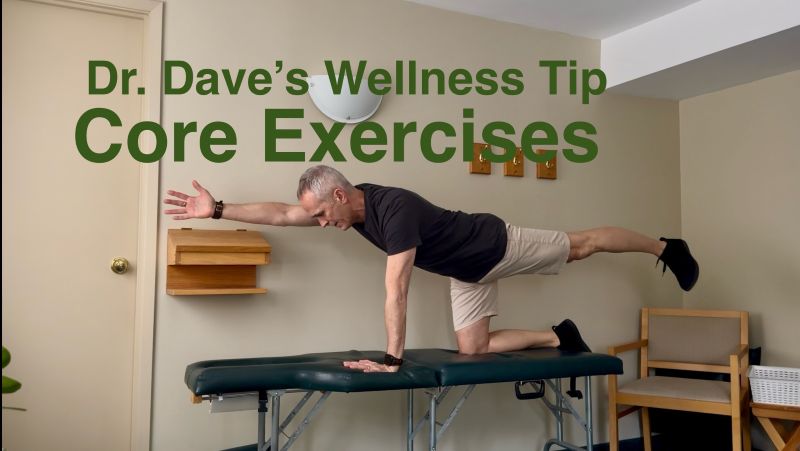
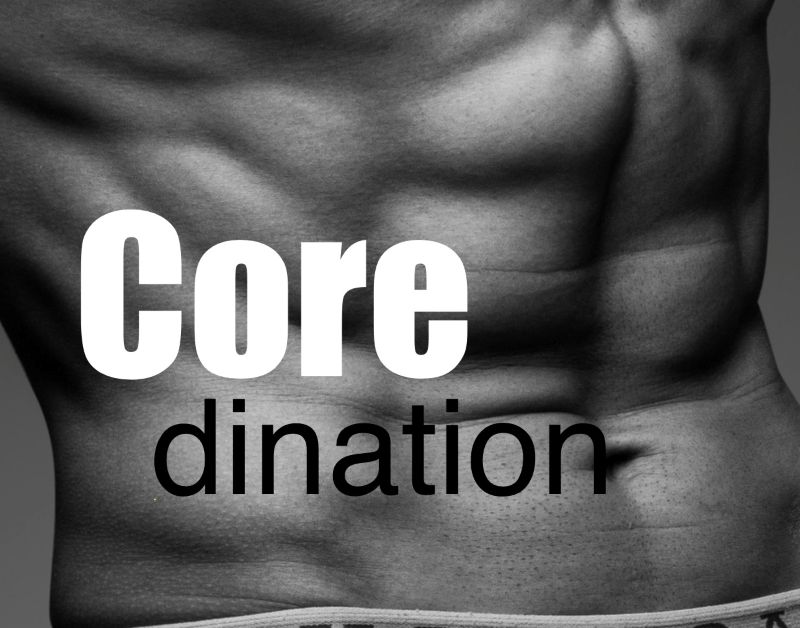
This month, I would like to address the importance of your core. If your core is weak, it will affect how movements like lifting your arm or leg will put stress on your spine and you will be more prone to injury. Having a strong core is not about having a “6 pack” or wash board abs like the fitness model in the photo above, (Okay, it was me, I lifted my shirt to demonstrate core but thought I could disguise myself by making it black and white…).
A strong core is like having a corset- it keeps the organs in place and protects the spine. It allows you to have good posture which, in turn, will take stress off of your joints – preventing excess wear and tear that lead to arthritis. Your core muscles must “turn on” before you reach to lift something, even as simple as your water bottle. If they don’t turn on, or they turn on too late, then the stress from the extra weight on your arm will be translated directly to your spine and can cause or re-aggravate an injury. There must be COREdination. (Okay, I’ll stop with the puns now).
Your core is also important for digestion as it supports the gastrointestinal tract. A strong core will aid in motility and reduce bloating and constipation by maintaining proper abdominal pressure.
With all exercises, it is important for the transverse abdominis muscle to be active. You can work on this by standing with straight posture and placing your baby fingers on the bone that sticks out at the front of the pelvis, while your thumbs rest on the bottom of your front ribs. As you breathe in, think of getting longer and leaner, making the distance between thumb and baby finger get longer and feeling the lower back stretch, while keeping the shoulders and upper body relaxed. Hold this contracted muscle for 30 seconds and take a break and then repeat it. This can also be done lying down. (see our video by clicking on the picture below)
The McGill big 3 are a series of exercises that will strengthen and maintain your core. Together, they address the different aspects of the core, protecting the front, side and back of the body. By clicking on the picture below, you may watch a video of me demonstrating the exercises.
- Modified Crunch. 2 sets of 10. Lie on your back with your knees bent and feet flat. Place your hands under your lower back. Squeeze your abdominal muscles to lift your chest up and hold for 2 seconds at the top of each crunch. Make sure to keep your neck in line with your chest, do not flex it up.
- Side Plank. Begin by lying on your side with your knees bent and support your upper body on your elbow. Place your upper hand on your upper hip. Lift your hips so your body weight is supported only by your knee and forearm and then slowly lower back down. Repeat this for 20-30 seconds. This can also be done with your legs straight to make it more challenging.
- Bird Dog. Begin on hands and knees, with your back in a neutral alignment. Extend one leg backward without allowing any movement in the lower back while simultaneously raising the opposite arm forward until both are fully straightened. To prevent over-arching the back during the leg movement, focus on kicking the heel straight back. If performing arm and leg movements together is challenging or causes discomfort, try the modified version with doing arm movements separate from leg movements.
An alternate to Bird Dog is Dead Bug. This is particularly good if you find it difficult to go on your hands and knees. Lie on your back with arms pointing straight up and knees pointing to the ceiling with shins parallel to the ground. Slowly reach one arm to point above your head as you extend the opposite leg to an outstretched position, not touching the arm or the leg on the ground. Make sure to maintain a long back, with the belly button pulled in and the lower back pressing into the floor. Repeat with the opposite arm and leg.
If you aren’t working on your core, then it is probably deteriorating! Take some time to strengthen your core- your body will thank you for it!